
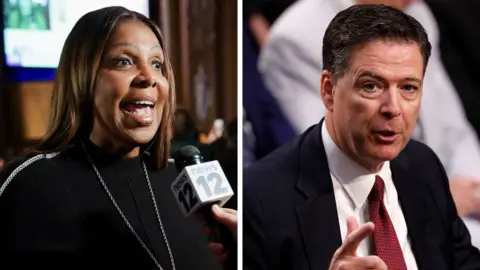
A pair of well-known critics of former President Trump secured significant legal victories on Monday when a US judge dismissed the government's charges against them.
For weeks since their indictments, former FBI Director James Comey and New York Attorney General Letitia James have argued vehemently that they are innocent, claiming that the administration and DOJ are simply targeting them for retaliation.
US District Judge Cameron Currie dismissed the indictments against them due to prosecutor Lindsey Halligan's invalid appointment as federal prosecutor. But she also left the door open for the government to refile the case.
- Judge dismisses charges against ex-FBI director Comey and NY attorney general James
- US judge says government 'missteps' may have compromised Comey case
- What is former FBI head James Comey accused of?
Comey admitted that possibility after the decision, saying he thinks Trump will probably come after him again.
And White House spokeswoman Abigail Jackson appeared to agree: This isn't the final word on this issue.
But the DOJ confronts steep hurdles to effectively try both after this setback, and experts are reluctant to predict what could happen next due to the unprecedented circumstances of the cases.
It feels to me like uncharted territory, said Professor Kay Levine, Emory University School of Law professor.
Could the justice department appeal?
The DOJ can challenge the judge's decision before a federal appeals court. In this instance, that would be the Fourth Circuit Court of Appeals.
Attorney General Pam Bondi signaled she would pursue this option, vowing to use all legal means, including an expedited appeal.
In other cases, the Trump administration has aggressively appealed unfavourable rulings, taking cases from lower courts and sometimes accelerating its requests up to the Supreme Court.
Attorney Abbe Lowell, James's lawyer, pledged to continue to challenge any further politically driven indictments through every lawful means available.
If there is an appeal, the justice department probably would have its own attorneys present the arguments, making Halligan's involvement in the appeals process unclear.
Could there be new charges?
The government accused James Comey with lying to Congress and obstruction of justice. Federal prosecutors charged Letitia James with bank fraud and making false statements to a bank.
Both pleaded not guilty. In addition to arguing Halligan's appointment was invalid, they also asserted to be victims of retaliatory legal action.
With the original indictments thrown out (though, of course, appeals could change that), the government might try to assemble fresh grand juries and obtain new charges.
Based on my analysis, a different attorney could bring James' case to a different grand jury and secure a new indictment, stated Ms Levine.
But John Day, president of the American College of Trial Lawyers, said it could be a complicated path – certainly in Comey's case.
I can tell you it will be hotly contested, whether Comey's case can be re-indicted if a properly assigned attorney is appointed and is able to secure an indictment.
He described the complex web of lawyers, judges, and legal filings involved as a legal quagmire with no easy solutions.
It could be harder for the government to try to file the exact same charges against James Comey.
A key issue is the legal time limit – the time frame that prosecutors had to charge him for these particular claims – which ended at the close of September. However, the dismissal of the charges would trigger a half-year extension for the DOJ to refile the case.
Even so in that case, his lawyers said it plans to contend the prosecution is past the deadline.
The ruling also suggests that because the charge is invalid, the statute of limitations has expired and there can be no further indictment, lawyer Patrick Fitzgerald said Monday.
What is the fate of Lindsey Halligan?
In the pair of rulings on the indictments against James and Comey, the judge was blunt: Halligan's appointment was improper.
Judge Currie wrote in the James decision that the Attorney General's attempt to install Ms. Halligan as Acting US Attorney for the Eastern District of Virginia was invalid.
Therefore, she had no lawful authority to file the charges, she wrote.
Federal prosecutors are proposed by the president and need Senate approval. US laws regulate how individuals can be assigned on a temporary basis, but Judge Currie found that Halligan's assignment had violated these laws.
This makes Halligan's role on future cases against James and Comey, again, uncertain.
The ruling also could raise doubts on other cases Halligan has brought in the Eastern District of Virginia where she works.
But Bondi said on that day that she designated her a special federal prosecutor and praised her work as outstanding.
The White House stood by its stance that Halligan's appointment was legal, spokesperson Karoline Leavitt told reporters on Monday.
